

Article May 21, 2026
How to support your child with autism if they’re not coping at school

Every day, numerous autistic children walk out of school with their teachers believing the day went well. They may have sat through lessons, answered questions, and made it through to the final bell. But by the time they reach the front door at home, everything they’ve been holding in all day comes out at once.
For others, the distress can show up in school, but it’s often misunderstood. What teachers may see as misbehaviour can be meltdown. Actions that look like defiance, such as refusing to answer a question, may instead stem from anxiety and extreme sensory overwhelm.
School-related distress can look different in every child with autism, but sadly, it’s an all-too-common reality no matter how it presents. If your child isn’t coping in school, we’re here to help. Let’s take a look at the reasons behind the struggles, strategies to try at home and at school, and other pathways to consider.
In a nutshell: Autistic children often struggle at school because of sensory overload, anxiety, masking, and an environment not designed for them. The most effective responses combine home adjustments (like fewer demands and more predictability) with school-based advocacy (such as reasonable adjustments via the SENCO or an EHCP for more complex needs). When mainstream school is not the right fit, options like online education can offer an environment that removes many of the triggers at the root of school distress.
Why do autistic children struggle at school?
Autistic children can struggle at school for many well-documented reasons, including sensory overload, anxiety, daily stressors, and the hidden toll of masking.
Sadly, according to research from the Newcastle University, ‘school distress’ (significant emotional distress related to attending school) occurs far more often in children with autism. Some of the most recognised causes include:
- Sensory overload from noisy corridors or bright classrooms
- Anxiety linked to routine changes and uncertainty
- Navigating social dynamics and unspoken cues
Some young people also experience school-related trauma from incidents such as bullying or being punished for stress behaviours, which can make the classroom itself feel unsafe.
In addition, many children engage in ‘masking’, suppressing or hiding their autistic traits in order to fit in. These efforts can be exhausting, so while a child may appear to be coping, they are often spending enormous reserves of energy simply to seem ‘fine’. When those reserves run out (which, in the most significant forms, is known as ‘autistic burnout’), the consequences can be sudden and severe.
Signs your autistic child isn’t coping at school
For parents, one of the biggest challenges can be that distress in children with autism doesn’t always look the same as neurotypical distress, especially at school.
The National Autistic Society notes that it is quite common for autistic children who appear fine at school to behave very differently at home. This is often due to masking; children may show no outward behavioural difficulties during the school day but come home and fall apart (often referred to as the ‘after-school restraint collapse’).
“Children often mask at school… and then they come home and just have to let it all out. There can be huge meltdowns when kids come home from school because they've just been bottling this in all day.”
Co-Director of the Centre for Neurodiversity and Development at Durham University
Catching these struggles early is important. Even if school reports that things are “fine,” signs your child may not be coping include:
- Extreme fatigue or withdrawal after school, including needing to decompress alone for long periods
- Meltdowns or emotional outbursts shortly after arriving home, often with no obvious trigger
- Increased anxiety or irritability in the evenings that doesn’t match how their day was described
- Reluctance to talk about school, or strong resistance to going back the next morning
- Physical complaints like stomach aches or headaches that ease at weekends and during holidays
What to do if your autistic child isn’t coping at school
If your child isn’t coping at school, there are two avenues to explore: supporting them at home and ensuring they’re supported better in the classroom. Often, a mix of both approaches will be the best way to get your child feeling happy and confident in their learning again.
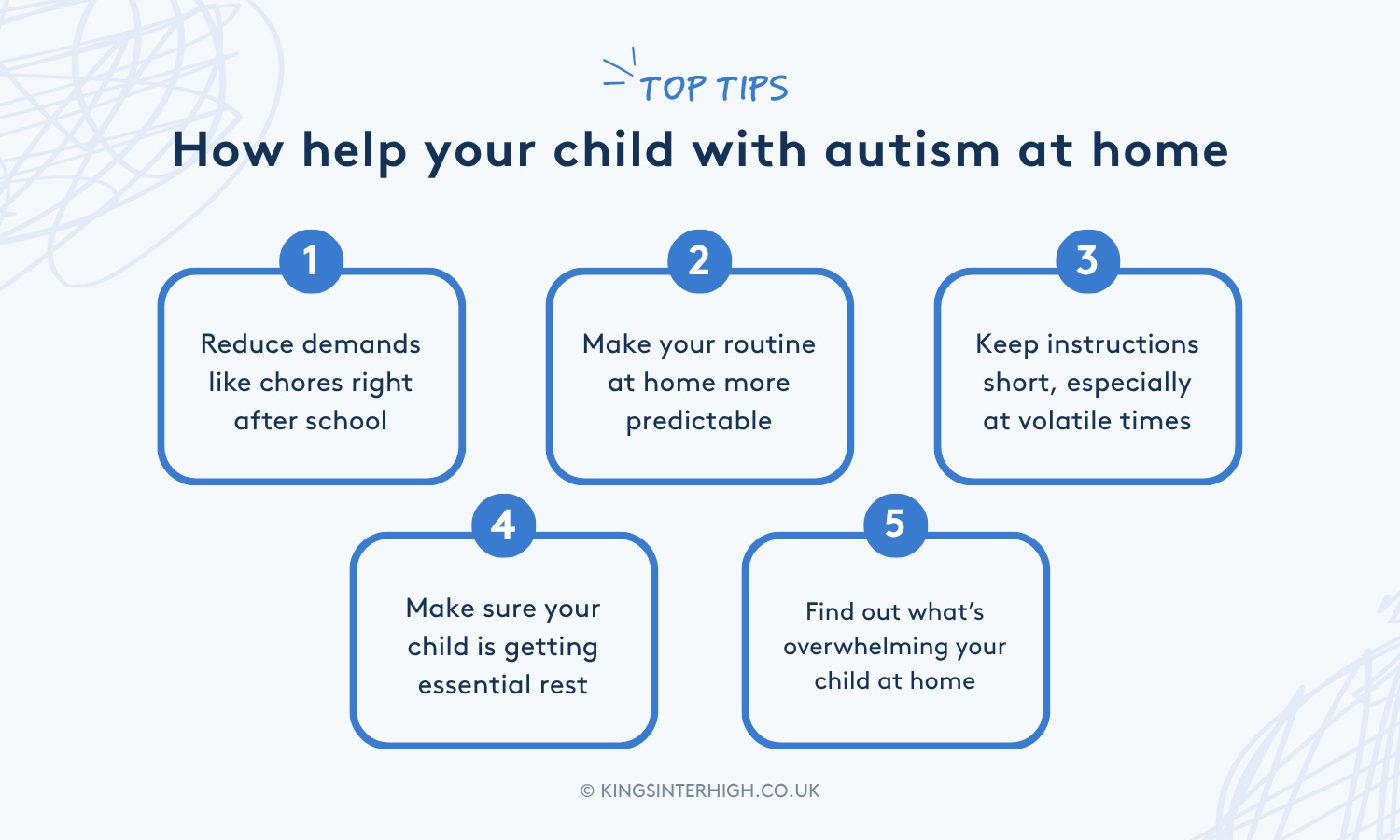
5 practical autism support strategies to try at home
No two children experience school difficulty in the same way, and the strategies that help best will vary. The common thread is that the right approach will be tailored to your individual child. Here are five approaches that many families find useful.
- Reduce demands after school: After a long day of managing sensory input and social expectations, many autistic children feel depleted when they get home. As such, you may find it helpful to reduce or remove demands like homework, questions, and chores during the first hour or two after your child gets home. This can give your child more time for activities they find regulating, like play, music, or quiet time.
- Make home more predictable: If school is already demanding lots of adaptation from your child, reducing uncertainty at home can give them space to recover. For younger children, this could include supports like visual schedules. For older children and teens, try shared calendars, written plans, and text reminders.
- Keep instructions short: When your child is overwhelmed, they may find language harder to process. In turn, long explanations or repeated questions can potentially lead to meltdowns. Instead of asking, “Why aren’t you ready? We’re going to be late,” try, “Let’s put our shoes on now, then we’ll leave.”
- Protect your child’s sleep: Poor sleep significantly worsens emotional regulation, sensory tolerance, and the ability to cope at school. A predictable bedtime routine, reduced evening demands, dim lighting, and sensory-friendly bedding can all help your child get better rest. On weekends, try letting your teenager sleep in longer.
- Find out what’s overwhelming them: As many parents of children with autism know best, meltdowns, shutdowns, and refusal aren’t always deliberate defiance. If your child is still feeling overwhelmed at home, try to involve your child in identifying their triggers so you can build coping skills together.
If your child’s anxiety around school is beginning to impact their daily functioning, it’s also important to speak to your GP about ways they may be able to help, such as therapy referrals.
How to work with your child’s school to get autism support
Children with autism have clear rights when it comes to accessing support at school, but getting the right support often relies on knowing the routes available and exactly what to ask for. If you’re not sure where to start, here are four first steps to try:
- Talk to the SENCO: As suggested by the NHS, your first point of contact should be your child’s teacher or the school’s Special Educational Needs Co-ordinator (SENCO). The SENCO is responsible for overseeing SEN support and coordinating adjustments for children who need them.
- Bring evidence with you: When you meet with your child’s school, come prepared with any observations, reports from professionals, or concrete examples of situations where your child has struggled. Typically, the more specific you are, the fewer difficulties you’ll experience.
- Request practical changes: From this discussion, you can request reasonable adjustments to how your child is taught and supported. These might include access to quiet spaces when they are overwhelmed, communication supports like visual cues, or permission to use sensory aids during lessons.
- Document everything: Keep written records of everything agreed in these meetings. A brief email summarising what was discussed can create a record and help keep everyone accountable. If adjustments are promised but not implemented, follow up in writing.
If your child needs more support than a mainstream school can provide through adjustments alone, the typical route is to request an Education, Health and Care Plan (EHCP) from your local authority. An EHCP is a legally binding document that sets out your child’s needs and the specific provision they are entitled to. An EHCP is also typically required for a special school placement.
If conversations with school stall or decisions from the local council are not what you hoped for, your local SENDIAS service (Special Educational Needs and Disability Information Advice and Support) can offer free, impartial guidance on your rights and options. The National Autistic Society also runs a dedicated education rights helpline. The process of accessing support can be slow and, at times, tiring, but you are entitled to ask questions, challenge decisions, and keep pushing.
What’s changing: the 2026 Schools White Paper
While EHCPs have been the main route in recent years, the SEND system in England is currently undergoing significant reform. In February 2026, the government published its Schools White Paper, which proposes a new tiered structure for support. Under these proposals, children with additional needs will move through four levels: a ‘universal’ offer for all children, followed by Targeted, Targeted Plus, and Specialist support for those with greater needs.
Under this proposal, all children with SEND would receive a new Individual Support Plan (ISP) developed with parent input, setting out day-to-day provision in practical detail. EHCPs will remain in place for children with complex needs, and no changes to existing EHCP support will begin before September 2030. These proposals are currently being consulted on, but they represent a clear signal of where the system is likely to head.
Looking after yourself too
According to research from the Salvesen Mindroom Research Centre, parents of autistic children are consistently more stressed than those of non-autistic children. Remember to prioritise your self-care and seek more support if you’re struggling. YoungMinds operates a free Parents Helpline, and the National Autistic Society also provides advice and guidance for families at every stage.

What to do when your child won’t go to school
School refusal is more common among autistic children than many parents realise. Government data confirms that autistic pupils are more likely to be absent from school, and Ambitious About Autism’s 2025 Lost Learning Report found that nearly three-quarters (71%) of autistic learners experience at least one form of lost learning in mainstream education.
Is online school right for your autistic child?
While support at home and school can go a long way in helping your child cope, you’re not alone if you feel like there’s a mismatch between your child’s needs and the way mainstream school often works.
“Autistic children frequently feel overwhelmed by the pressures of spending long periods of time in an environment which is… not designed for autistic ways of being.”
Centre for Autism researcher and practitioner at the University of Reading
In their Lost Learning Report, Ambitious About Autism found that many parents agreed on the supports that would help their children most: teacher training, more accessible environments, adaptable learning, and greater recognition of individual achievement.
These are all qualities that have led many parents to choose King’s InterHigh. For children with autism, online school can offer a game-changing environment without the sensory overload of busy corridors or the need to mask in the classroom. One in three of our students has a special educational need, and our school is built with personalisation and inclusion in mind from the ground up.
“To have your child in the morning saying, ‘Please, I don’t want to go to school’ when you’ve got to get to work yourself is really stressful. The difference in him [since joining King’s InterHigh is just amazing. I wake him up in the morning when I'm home, and before I even ask, he's logged on and ready.”
Who has autism and ADHD → READ THEIR STORY
Every one of our teachers is trained in inclusive education, and every student with autism joins us with an Inclusive Teaching Plan (ITP): a range of personalised adjustments developed with you that goes directly to every teacher, ensuring your child gets the support they need in every subject from day one. Adjustments can include exemptions from using a webcam and microphone, a more flexible timetable, and adapted homework assignments and deadlines; plus, you can update your child’s ITP at any time as their needs evolve. For students who need more targeted support, we offer Enhanced Support Services such as anxiety management and social skills sessions.
“She got her confidence back at King’s InterHigh. She got confidence and a love for learning back very quickly.”
Who has autism → READ THEIR STORY

The environment itself also makes a major difference. King’s InterHigh’s virtual classrooms are interactive and collaborative, but free from the sensory and social demands found in mainstream school, allowing children to learn at home where they’re most comfortable. With more than 100 clubs per year themed around a range of interests and the opportunity to join low-pressure social meetups in person, many King’s InterHigh students who previously struggled with socialising find that they can make friends for life in our community.
The difference between coping and thriving
When the environment fits the child, rather than the other way around, everything changes. That might mean adjustments within mainstream school, or it might mean a different type of education entirely, but the starting point is always the same — knowing your child deserves a school experience shaped around who they are.
Share: